
Training on the clock
Health and safety training during normal working hours, at your regular rate of pay. Part 46 and Part 48 set the hours you are owed.
Miner rights
Training on the clock, an inspection when you ask for one, and no punishment for reporting a hazard. The rights belong to every miner, and they only work if you know them.
Report a hazard · anonymous if you choose
1-800-746-1553
MSHA’s 24-hour line for violations, hazardous conditions, and imminent danger. You do not need to identify yourself.

Miner rights
Every miner has the right to a safe, healthy workplace.
The film · 1800s to today
Chapter One · 1800s – 1907
Before there was a law
1 / 7
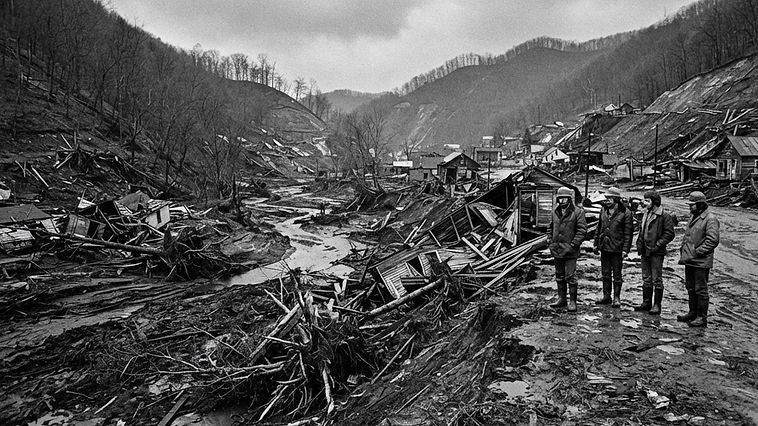
Illustrative imagery, not archival photography. Dates, mines and casualty figures are from the public record. · The narration is in English.
Chapters
Transcript
Before there was a law
For most of American mining history, the only safety rule was the one the operator wrote for himself, and he wrote very few.
Coal came out of Pennsylvania by the ton through the eighteen hundreds, cut by men lying on their sides in seams three feet high, hauled by mules and by boys. In the breakers above ground, boys sat astride the chutes pulling slate out of the coal with their bare hands, twelve hours a day, breathing dust that stayed in their lungs for the rest of their short lives.
The mines were ventilated by a furnace at the bottom of a single shaft. One shaft meant one way in, one way out, and one way for a fire to find the air it needed. Gas was a fact of the work. Men carried a flame on their hats to see by, and that flame could not tell them anything until it was already too late.
Whole towns belonged to the companies. The house, the store, the doctor, the school, the preacher, all of it on the company ledger, paid in scrip that spent only at the company store. A man who complained about a bad roof did not lose an argument. He lost his house.
There was no federal mine safety law. Not one requirement, not one inspector, not one penalty.
In nineteen oh seven, American coal mining killed three thousand two hundred and forty two men and boys in a single year. On the sixth of December that year, at Monongah in West Virginia, two connected mines blew apart within moments of each other, and three hundred and sixty one men and boys died. It is still the worst mining disaster this country has ever had.
The country was shocked, and being shocked is not the same as being protected. It would take sixty more years, and tens of thousands more funerals, before the law would finally say out loud what miners had been saying all along. A man’s life is not a cost of production.
On the job


Your rights
Every one of these comes out of the Federal Mine Safety and Health Act of 1977. We cover them in new miner training and again in annual refresher.
Health and safety training during normal working hours, at your regular rate of pay. Part 46 and Part 48 set the hours you are owed.
File a safety or health complaint with MSHA, a state agency, your operator, or a miners’ representative. You do not have to identify yourself to report a hazard.
Ask for an inspection where you believe an imminent danger, or a violation of the Act or a standard, exists.
Select a representative for safety and health purposes, and take part in the inspection as that representative.
Leave the mine when the required health and safety training has not been provided.
Be paid during certain periods when a withdrawal order has closed the mine, or the part of it where you work.
Refuse work you believe is unsafe, unhealthy, or illegal, after notifying the operator and giving them a chance to correct it.
A medical evaluation, or consideration for transfer to another job location, because of harmful physical agents or toxic substances.
Take part in Mine Act proceedings: testify, assist, or file a complaint with the Federal Mine Safety and Health Review Commission.
Exercise any right under the Act. Firing, cutting pay or hours, or denying overtime or a promotion for doing it is illegal.
The other side
The law protects miners who use it the right way. These are the limits that matter most in the field.
Always
Never
Section 105(c) · discrimination
Firing, denying overtime or a promotion, reducing pay or hours, or any other punishment for exercising a right under the Mine Act is discrimination. File a complaint with MSHA within 60 days of the act. MSHA can investigate and take the case to the Federal Mine Safety and Health Review Commission on your behalf.
Get the complaint packetForms and booklets
Official MSHA documents, straight from the source. Post the rights notice where miners actually take their breaks.
Free quiz
Eight questions pulled from the Mine Act and MSHA’s own rights booklet. Download it, print it, and run it at your next safety meeting. Answers are on the last page.
PDF · 2 pages · no charge
Next step